Memory Lock Behavior: Heap Usage at Target Bounds
Context
During our GC tuning campaign, we observed an unexpected but highly desirable behavior: memory usage didn't just stabilize—it "locked" firmly at the preset target boundaries.
Production Observation
During Campaign (Steady State)
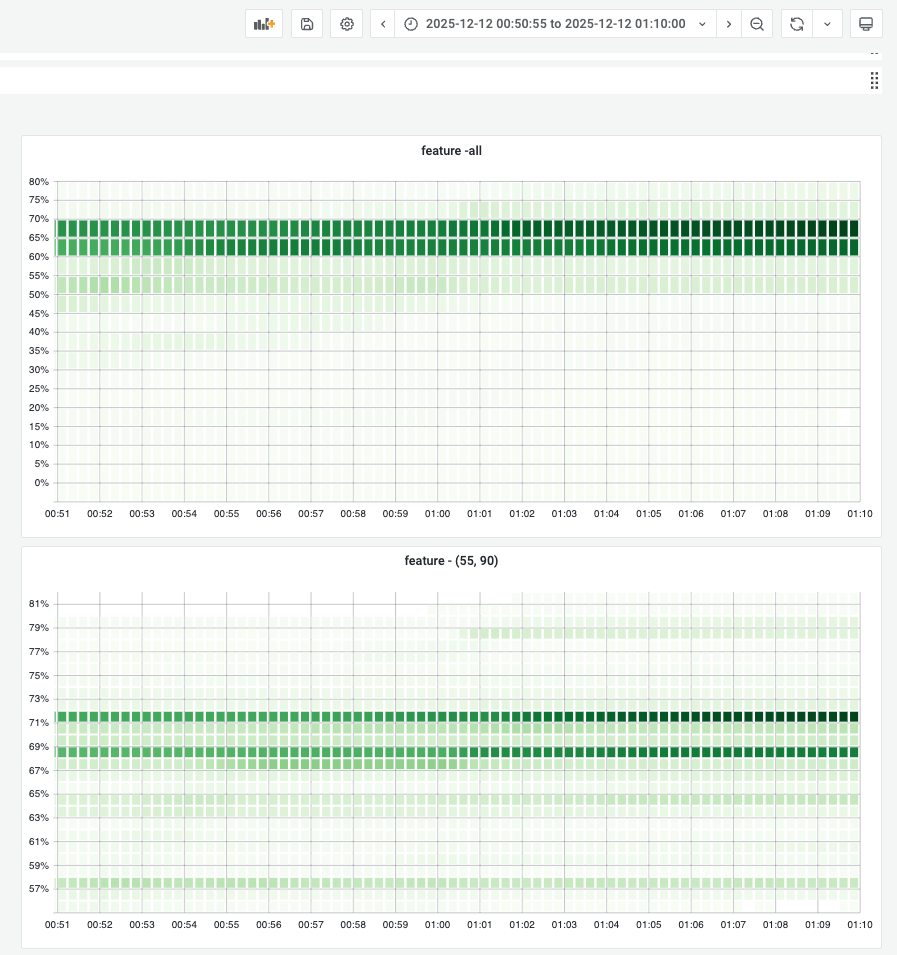
Observations: 1. Memory stability: Heap usage stabilized at expected level (not growing unbounded) 2. Limit enforcement: No services hit GOMEMLIMIT OOM 3. Predictable behavior: Memory "locked" at target bounds 4. Expected behavior: Vast majority of container memory usage met expectations, remained stable
Key finding: During the campaign, memory was firmly locked at preset boundaries, demonstrating high stability of the overall solution.
What Causes This Behavior?
The "lock" effect is the result of several mechanisms working together:
- GC Pacer target accuracy: The Pacer calculates the trigger point precisely based on
GOGCand live heap size - Scavenger buffer retention: Without
GOMEMLIMIT, the runtime retains a 10% buffer above target - Steady-state allocation: In production services with stable traffic, allocation rates are predictable
- Feedback loop: The allocation-assist mechanism provides natural backpressure when heap approaches limit
Why This Matters
Before observation: Concerns that memory would fluctuate wildly or grow unbounded
After observation: Confidence that: - Memory usage is predictable and bounded - The GC Pacer + GOMEMLIMIT combination provides tight control - Operations planning can rely on stable memory profiles
Quantitative Evidence
From our campaign across 67 services:
- Zero OOM incidents: No services hit
GOMEMLIMITout-of-memory - Clear ceilings: Memory usage graphs show visible "ceilings" at expected levels
- Stable baselines: 10-minute rolling windows showed minimal variance (<5% jitter)
Theoretical Validation
This behavior confirms our understanding from multiple GC articles:
- Pacer Theory: The trigger point calculation (
trigger = live_heap + (target_heap - live_heap) / assist_ratio) provides accurate heap control - Scavenging Theory: The runtime manages idle memory efficiently, returning only what's truly unused
- Allocation-Assist Loop: The feedback mechanism prevents runaway heap growth
Practical Implications
For Capacity Planning
- Memory usage can be accurately predicted based on target heap settings
- No need for large "safety margins" beyond the
GOMEMLIMITbuffer
For Alerting
- Alert thresholds can be set close to the target (e.g., 95% of
GOMEMLIMIT) - Minimal false positives from normal fluctuation
For Tuning
- Higher confidence in pushing
GOGChigher - Memory behavior is deterministic, not probabilistic
Related Topics
- RSS vs Heap Target - How RSS differs from heap target
- Scavenging Theory - How the runtime manages idle memory
- GC Pacer Theory - Target calculation and trigger points